Create printable Pythagorean theorem worksheets with missing hypotenuses or legs, integer or square-root answers, and separate worked solutions. Choose a reproducible variant and preview each page before exporting.
Live preview210 × 297 mm
A4
Preview is scaled to fit. The PDF keeps the exact dimensions.
PDF and Print include all pages. PNG and SVG save the page shown.
For true-size printing: choose 100% / Actual size, match the paper size and turn off headers and footers. Printing guide ↗
Ready for your printer
Build a focused right-triangle practice sheet
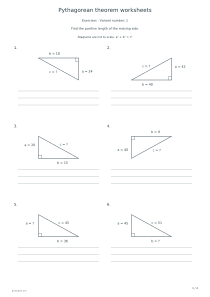
Use this generator for a short lesson starter, independent revision or a homework sheet. Each problem gives two side lengths and asks for the third. Begin with one missing-side type so learners can concentrate on choosing the operation. Move to mixed sides after they can identify the hypotenuse in several orientations. The small square marks the right angle, even when the triangle is turned around.
💡A few useful answers
Can students measure the drawings to find the answer?
No. The triangles are schematic and explicitly marked as not to scale. Their orientation and appearance help students locate the right angle and side labels; they do not encode measurable lengths. Use the printed numbers for every calculation. A ruler measurement from this sheet is not a valid check of the mathematical answer.
Does the worksheet include word problems or angle calculations?
This tool produces labelled right triangles with one missing side. It does not generate story problems, trigonometric ratios, angles or proofs of the theorem. You can add an oral context during the lesson, but keep the given side lengths in the same unit. A numerical answer represents a length, not an area.
How can I share only the student sheet?
Turn off worked answers before downloading a student PDF or printing the complete set. PNG, SVG and Share use the page currently selected in the preview, whereas PDF and Print include all generated pages. A Share link also preserves the worksheet settings. Check the selected page and answer setting before sending it to a class.
Read the triangle before calculating
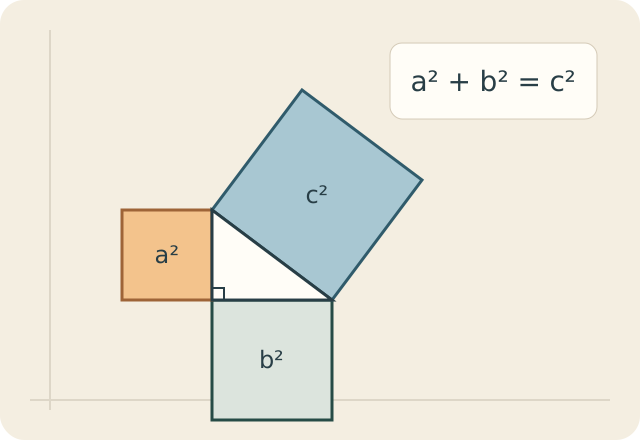
The letters a and b mark the two legs meeting at the right angle; c always marks the opposite side. For a missing hypotenuse, add the squares of the known legs: c² = a² + b². For a missing leg, subtract the other leg's square from the hypotenuse's square. Take the positive square root because a side length cannot be negative. Write the substitution first rather than trying to guess a familiar triple.
Whole-number mode selects Pythagorean triples, so every missing length is an integer. Square-root mode deliberately uses non-square results and shows both an exact radical and a rounded decimal in the answer key. For example, √72 simplifies to 6√2, not 36. Choose one, two or three decimal places for the approximation. Keep the unrounded value during calculation and round only the final length; the equals sign and approximation sign describe different kinds of answer.
Plan the practice and review the working
✏️Choose 6, 12 or 24 exercises and a largest side of 60, 100 or 200. This limit applies to the actual side lengths, not their squares. Larger numbers increase arithmetic work but do not guarantee a harder conceptual task. The same variant and exercise settings reproduce the same questions. Changing page size, colors, answer visibility or decimal precision changes presentation, not the underlying triangles. Use graph paper alongside the sheet if a learner needs more room to organise calculations.
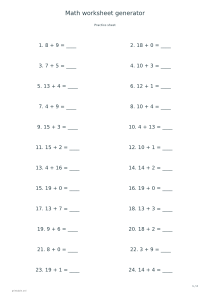
🖨️Select A4, A5, A3 or US Letter before printing. The generator places extra exercises on additional pages instead of squeezing everything onto one sheet. Worked answers follow the exercise pages and use matching numbers; remove those pages before distributing a student copy. A dark ink on white paper usually gives clear pencil contrast. For a shorter arithmetic warm-up, use the math worksheet generator before introducing squares and roots. Discuss the student's method as well as the final number.
Pythagorean theorem worksheets
Example: an integer hypotenuse
Choose Hypotenuse, Whole-number answers, largest side 60, six exercises and variant 1. Keep A4 portrait and worked answers enabled. The first triangle has legs 18 and 24: c² = 324 + 576 = 900, so c = 30. The worksheet has one exercise page followed by one answer page. Ask the learner to explain why addition is appropriate before checking the result.
Choose Leg, Square-root answers, largest side 60, six exercises and variant 1, with two decimal places. The first problem gives c = 25 and b = 4. Then a² = 625 − 16 = 609, so a = √609 ≈ 24.68. This result is slightly shorter than the hypotenuse, as it should be. The example link preserves these settings, including the answer pages.