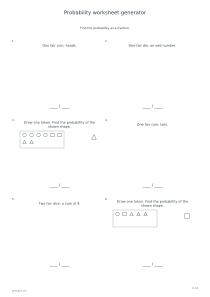
Make probability worksheets about fair coins, six-sided dice and a single draw from a bag. Choose an experiment, set the question count and include answers with reduced fractions and outcome counts.
Live preview210 × 297 mm
A4
Preview is scaled to fit. The PDF keeps the exact dimensions.
PDF and Print include all pages. PNG and SVG save the page shown.
For true-size printing: choose 100% / Actual size, match the paper size and turn off headers and footers. Printing guide ↗
Ready for your printer
Start by naming the experiment and the event you want to count. Probability in these worksheets compares favorable outcomes with all equally likely outcomes, so choosing the right outcome set matters before any fraction is simplified. Ask the learner to explain the numerator and denominator in words, then connect that explanation to the reduced fraction in the answer key.
💡A few useful answers
Are all sums of two dice equally likely?
No. The equally likely outcomes are the ordered pairs from two fair independent dice. Some sums can be made by more pairs than others. List the pairs for the requested sum and compare that count with the complete outcome set. The number of different sums is not the denominator for this experiment.
Why show outcome counts as well as a reduced fraction?
The counts reveal how the answer was obtained before simplification. A reduced fraction can hide the original size of the outcome set while retaining its probability. Asking the learner to explain both counts helps distinguish understanding of the experiment from recognizing a familiar fraction or making an error while reducing it.
Can this worksheet test whether my actual coin is fair?
No. These questions assume fair objects and independent trials. They do not collect observations or draw a statistical conclusion about a physical coin or die. Investigating that question requires a separate record of real results and a different discussion from calculating probabilities within a specified equally likely outcome set.
Identify the experiment and the event
✏️Coin questions use one fair coin or two independent fair tosses. They can ask for heads, tails, an exact number of heads or at least one head. With two tosses, heads followed by tails and tails followed by heads are separate outcomes. At least one head includes the two-heads outcome as well.
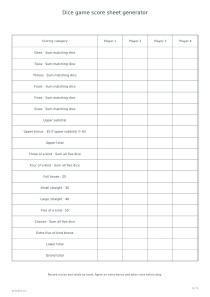
A single fair six-sided die supports questions about even or odd values, an exact face and values above a threshold. Two independent dice support questions about their sum. The sums are not equally likely: several ordered pairs can give the same total. Count those pairs rather than treating each possible sum as one equally likely outcome. For a separate game with handwritten results, use a five-dice score sheet; keep this worksheet focused on explaining the probability model.
Count equally likely outcomes
Bag questions show three to twelve symbolic tokens drawn from three shapes. Every individual token is equally likely in one draw, and the requested event is the displayed target shape. Count all matching tokens, not just the number of different shapes. Shape differences carry the information without depending on color. Have the learner point to the target, identify every favorable token and then count the complete collection before comparing the two quantities.
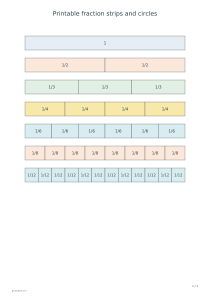
The key includes favorable and total outcome counts alongside the reduced fraction. Reducing changes the notation, not the event or its probability. A final answer of one half should still be connected to the original count that produced it. Fraction strips can support a discussion of equivalent fractions, while the outcome list explains why those particular counts belong to the coin, dice or bag question.
Explain the fraction before reducing it
📝Choose one scenario or mix all three. Six, twelve or twenty-four exercises produce one, two or four practice pages, with six questions on each. A positive arrangement code determines the set; keep the scenario, question count and code together when recreating a worksheet. A mixed page asks learners to recognize the model before calculating. For an introduction, work with coins first, then discuss why a pair of dice requires counting ordered pairs instead of counting only the possible totals.
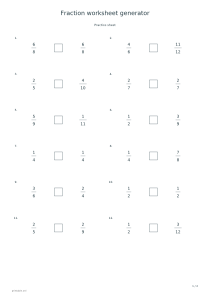
Optional answer pages follow all practice pages. Check the original counting before checking simplification, because the same incorrect fraction can come from different mistakes. Use fraction worksheets for separate arithmetic practice. This editor does not convert answers to percentages, simulate repeated experiments or assess whether a real coin is fair. PDF and Print include the whole set; PNG, SVG and Share use the selected preview page. The activities teach finite outcome sets and are not predictions or gambling advice.
Probability worksheet generator
A mixed introductory sheet
Select Mixed, six exercises and arrangement code 17, with answers enabled. The result has two pages: one practice sheet and its answer page. For each question, identify the experiment, count favorable and total outcomes, then write the reduced fraction and explain what event it represents.
Select Dice, twelve exercises and arrangement code 31, keeping answers enabled. Two practice pages are followed by two answer pages, making four pages altogether. For sum questions, compare the list of ordered pairs with the list of different totals to explain why the totals have different probabilities.