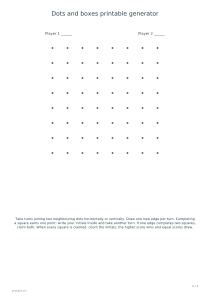
Make a printable dots and boxes board with adjustable rows, columns and dot spacing. Add player names and concise rules, then play with pencils and keep the score on the sheet.
Live preview210 × 297 mm
A4
Preview is scaled to fit. The PDF keeps the exact dimensions.
PDF and Print include all pages. PNG and SVG save the page shown.
For true-size printing: choose 100% / Actual size, match the paper size and turn off headers and footers. Printing guide ↗
Ready for your printer
Dots and boxes is a turn-taking pencil game about completing squares. A prepared board keeps the dots evenly spaced and leaves room to mark ownership. Use a small grid for a short game or a larger one for more decisions; the generator prints the board but does not play an opponent.
💡A few useful answers
What if one line closes two squares?
The player claims both squares, writes an initial in each and receives two points. The extra-turn rule still applies: that player draws the next legal edge. Count completed squares, not the number of edges drawn, so a long sequence of turns can produce several points before control passes back.
Can I use the grid for more than two players?
The printed name area is designed for two players. The dots can be used for an agreed multiplayer variant, but the generator does not add extra score fields or adapt its rules automatically. Decide the turn order, ownership marks and scoring before starting if you use a different arrangement.
Why can I not export my selected size?
The board must fit inside the page with its title, player fields, margins and optional rules. Large dot counts combined with wide spacing can exceed that area. The tool reports the problem so you can choose a smaller board, larger paper or a layout with the rules removed.
Size the board before you print
🎲Rows and columns count dots, not boxes. Eight columns and eight rows produce seven by seven possible squares, for a total of 49. In general, subtract one from each dot count and multiply the results. This distinction matters when choosing a game length: adding a row of dots creates a whole additional row of scoring squares.
Dot spacing ranges from eight to twenty-five millimetres. The physical board width is the number of horizontal gaps multiplied by that spacing, and the height follows the same rule vertically. A requested board that cannot fit is rejected rather than silently resized. Reduce the dot count or spacing, change orientation or use A3.
Play and score completed squares
Players take turns drawing one previously unused horizontal or vertical edge between neighbouring dots. Diagonal lines and long jumps are not legal edges in the printed rules. If that edge completes a square, write your initials inside it, score one point and take another turn. An edge can close two adjacent squares at once; both belong to that player.
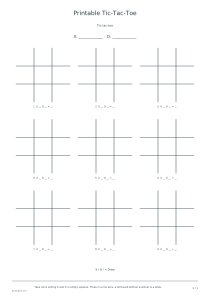
The game ends when every square has been claimed. Count each player’s initials to determine the score; equal totals are a draw. The name fields provide places to identify players and record the final numbers. For another compact pencil game, print tic-tac-toe boards, which use a different turn and winning structure.
Choose a manageable game
✏️For a first round, choose a smaller board so the effect of completing a third side is easy to observe. Later, look for chains of nearly completed squares and discuss the consequences of opening one. A bigger board offers more space but is not a formal difficulty rating. The board game maker suits a separate activity with numbered movement spaces.
Use different initials or pencil colours so claimed squares remain easy to count. Keep the printed rules on for a teaching sheet; switch them off when players already know the game and want extra board space. For free sketches or a different dot-based activity, dot grid paper supplies a general background without this game’s name fields and rules.
Dots and boxes printable generator
Columns: 6
For a short teaching game, choose six columns, six rows and 15 mm spacing on A4 portrait. The board measures 75 by 75 mm between the outer dot centres and contains 25 scoring squares. Leave the rules enabled and enter two names before printing the sheet.
For a wider game, choose twelve columns, eight rows and 15 mm spacing on A4 landscape. The board spans 165 by 105 mm and contains 77 squares. The same extra-turn and double-square rules apply; increasing the grid changes its size, not the way points are awarded.