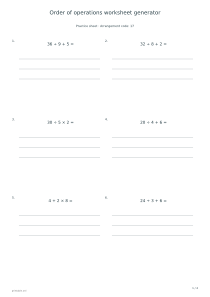
Generate printable order of operations worksheets with multiplication, division, parentheses and squares. Choose a practice level and get matching step-by-step answer sheets.
Live preview210 × 297 mm
A4
Preview is scaled to fit. The PDF keeps the exact dimensions.
PDF and Print include all pages. PNG and SVG save the page shown.
For true-size printing: choose 100% / Actual size, match the paper size and turn off headers and footers. Printing guide ↗
Ready for your printer
These worksheets help learners decide what to calculate first instead of reading every expression strictly from left to right. Each problem has a whole-number result and a matching reduction sequence. Use the questions for focused practice, then compare the intermediate lines to locate the step where an incorrect answer began.
💡A few useful answers
Is this a PEMDAS or BODMAS worksheet?
It practises the shared arithmetic convention behind those mnemonics: grouped expressions first, then powers, then multiplication and division from left to right, followed by addition and subtraction from left to right. The worksheet uses explicit operation symbols and parentheses. Neither mnemonic gives multiplication priority over division simply because its letter appears earlier.
Are fractions, negative numbers or cubes included?
This version uses nonnegative whole-number answers, exact division and squares only. It does not include fractional division results, negative bases, roots, cubes or nested powers. Keeping that scope explicit makes it easier to choose an appropriate exercise set without assuming the mixed option covers every algebraic expression.
Why can the answer exceed the selected number range?
The range controls sampled base numbers. An expression can multiply two of those numbers or square a grouped sum, so the final result may be considerably larger. Review the preview before handing out a set. Choose range 10 and the precedence level when you want smaller starting values without powers.
Choose the operations you want to practise
✏️The precedence level combines addition or subtraction with multiplication and exact division. Multiplication and division share a priority and are evaluated from left to right; addition and subtraction also share a priority. For instance, 12 ÷ 3 × 2 equals eight. It does not mean dividing twelve by the product of three and two.
The parentheses level includes grouped sums and differences, together with exact division of grouped expressions. Parentheses show which part belongs together; they are not decorations to remove before thinking. If a learner still needs practice with individual operations, start with basic arithmetic worksheets and return to compound expressions after the number facts feel manageable.
Read the worked solution as a sequence
The powers level introduces squares, written with the ^ symbol: 4 ^ 2 means four squared, or sixteen. It is different from four multiplied by two. Grouped bases can also appear, so (3 + 2) ^ 2 squares the whole sum. The mixed level cycles through precedence, parentheses and powers rather than representing a standardized difficulty score.
Choose operand range 10 or 20. That setting limits the sampled base numbers, not every displayed intermediate value or final answer: multiplication, grouped sums and squares can produce larger numbers. All generated divisions are exact, and the result is nonnegative. Fraction calculations belong in the separate fraction worksheet generator.
Prepare a manageable set of exercises
📝The answer section repeats each question and reduces one part at a time until only the result remains. Ask the learner to mark the next operation before looking at that line. Comparing two consecutive lines is often more useful than checking only the final number. A lined writing sheet gives extra space for explanations or a corrected solution.
Choose six, twelve or twenty-four questions and keep the variant number when you need the same set again. The paper format changes the layout, not the mathematical problems. On A4 portrait, six problems fit on each sheet; landscape uses fewer rows. The PDF places all question sheets before the answers, making it easier to hand out only the practice section.
Order of operations worksheet generator
Six precedence questions
Choose precedence, range 10, six questions and variant 17 on A4 portrait, with answers enabled. The first expression is 36 ÷ 9 + 5. The worked key shows 4 + 5 and then 9. The download has one question sheet followed by one answer sheet.
Choose mixed, range 20, twelve questions and variant 31 on A4 portrait, with answers enabled. The levels alternate in groups of three, giving four problems of each kind. Two question pages are followed by two matching answer pages. Reopening the example preserves the exact expressions and their order.