Make place value worksheets for two- to six-digit whole numbers. Practise expanded form, composing numbers, identifying digit values and comparing numbers, with printable answers.
Live preview210 × 297 mm
A4
Preview is scaled to fit. The PDF keeps the exact dimensions.
PDF and Print include all pages. PNG and SVG save the page shown.
For true-size printing: choose 100% / Actual size, match the paper size and turn off headers and footers. Printing guide ↗
Ready for your printer
Place value connects the position of a digit to the quantity it represents. In 407, the four represents four hundred, the zero marks an empty tens position and the seven represents seven ones. These worksheets offer several ways to practise that structure without changing the meaning of a number when a zero appears inside it.
💡A few useful answers
Does the worksheet include decimal place value?
No. This version covers positive whole numbers with two to six digits. It does not generate tenths, hundredths, negative values or numbers written in words. The number of digits is a range setting, not a school-grade label; choose it according to the learner’s current understanding and the task you want to practise.
Are zero terms required in expanded form?
The answer key includes one contribution for every position, including zero. This makes the correspondence between digits and positions easy to see. A learner who writes 400 + 7 for 407 has an equivalent expression; discuss whether the purpose of that particular exercise is showing every position or simply decomposing the number.
Can I print only the practice questions?
Yes. Switch off answers before exporting the PDF or printing. With answers enabled, all question sheets come first and the completed sheets follow in the same order. PNG, SVG and Share use the page selected in the preview, so check that you have selected a question sheet when preparing an individual exercise image.
Match the task to the place-value skill
✏️Choose between two and six digits. The generator produces positive whole numbers with exactly that many digits, so a four-digit set runs from 1000 through 9999. Internal zeros are possible and remain meaningful. Start with fewer positions when learners are still confusing a digit with its value, then increase the range once they can explain the difference.
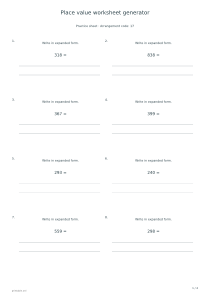
Expanded-form questions ask learners to split a number into place-value contributions. The answer for 407 is 400 + 0 + 7. Keeping the zero term visible helps show the unoccupied tens position; omitting that term is mathematically equivalent. Use number lines to connect the complete number with its position among neighbouring values.
Keep zeros and positions visible
The digit-value task underlines one digit and asks for its value in that position. In 572, an underlined seven has value 70. If an underlined digit is zero, its value is zero. The marked position cycles through the selected number of digits, so a longer set includes different positions rather than repeatedly asking about the first digit.
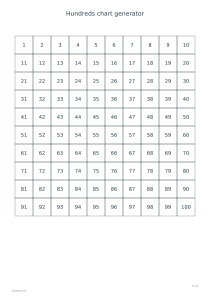
Composing-number questions present expanded contributions and leave the whole number blank. Read the positions carefully rather than joining every visible digit together: 300 + 0 + 8 becomes 308. A hundreds chart is a useful smaller-range companion for talking about how tens change while ones repeat down a column.
Use answers to discuss the number structure
📝Comparison questions use the symbols less than, greater than and equal to. Compare the highest position first, then move right until the numbers differ. Equal pairs are deliberately included, so equality is a real possible answer. The mixed task cycles through expanded form, digit value, composing and comparison to provide a short review across all four skills.
Choose six, twelve or twenty-four questions. Keep the same variant number to reproduce the set for a learner or retain a matching answer key. Review one response aloud before moving on: ask what the marked digit contributes and why. Follow with addition and subtraction worksheets when learners are ready to use the same positions in calculations.
Place value worksheet generator
Three-digit expanded form
Choose three digits, expanded form, six questions and variant 17, with A4 portrait and answers enabled. Every question has a number from 100 through 999 and space for its hundreds, tens and ones contributions. The PDF contains one practice page followed by its answer page.
Choose four digits, mixed tasks, twelve questions and variant 31 on A4 portrait. The set contains three questions of each task type. Eight questions fit on the first sheet and four continue on the second; two answer sheets follow. Keep the variant to reproduce the same underlined positions and comparison pairs.