Make printable money worksheets for counting denomination tokens or calculating change. Choose USD, EUR, GBP, UAH or PLN and include matching answer sheets.
Live preview210 × 297 mm
A4
Preview is scaled to fit. The PDF keeps the exact dimensions.
PDF and Print include all pages. PNG and SVG save the page shown.
For true-size printing: choose 100% / Actual size, match the paper size and turn off headers and footers. Printing guide ↗
Ready for your printer
Money practice connects place value and arithmetic with amounts written in major and minor currency units. These worksheets offer two focused tasks: add the values of pictured learning tokens, or subtract a price from an amount paid. The tokens show denomination values rather than reproducing official coins or banknotes, keeping the calculation readable across the supported currencies.
💡A few useful answers
Are the token drawings realistic coins?
No. They are simple circles containing denomination values. Their purpose is to make an addition problem visible, not to teach recognition of official coin designs. A large-looking token is not automatically worth more than a small-looking token, and the illustrations should not be used as identification references for real currency.
Does changing currency convert an existing worksheet?
No. Choosing another currency generates questions using that currency’s denomination set and labels. It does not exchange the original values at a market rate. Keep the same currency and variant when you need an exact repeat of a previous set; treat a currency change as a new exercise configuration.
How are the change answers calculated?
The tool stores and subtracts integer minor-unit amounts, then formats the result for display. The generated payment is greater than the price, so the expected change is positive. No sales tax, discount, tip or local cash-rounding convention is added; those would require additional facts beyond this worksheet’s two stated amounts.
Choose counting or change as the main task
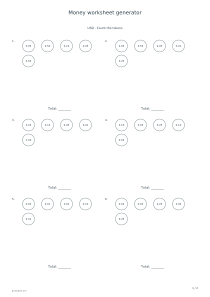
✏️Counting mode displays three, five or eight symbolic tokens per question. Read the value printed inside each token, then add the amounts. Tokens may repeat, and their drawn size does not indicate their value. Grouping equal denominations can be more efficient than adding every token separately, but learners should be able to explain why the grouped calculation gives the same total.
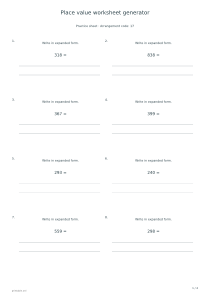
The currency selector offers US dollars, euros, pounds sterling, Ukrainian hryvnias and Polish złoty. The amounts use two minor-unit decimal places, with number punctuation adapted to the page language. The currency code identifies the unit of the whole worksheet. Use place value exercises when the relationship between the whole unit and its hundredths needs separate discussion.
Read values in the selected currency
The denomination sets differ by currency. For example, a familiar quarter-dollar value appears in the US set, while other sets use their own combinations of minor and whole units. The circles are teaching symbols, not reference pictures for identifying currency by appearance. They do not model the size, color, current circulation status or security features of physical money.
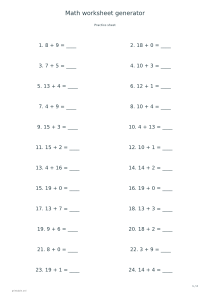
Change mode gives a price and a larger amount paid. Subtract the price from the payment to find the change. The generated amounts are exact integer minor units, so the answer does not depend on rounding a floating-point approximation. Review addition and subtraction practice if the arithmetic procedure is still taking attention away from interpreting the purchase scenario.
Use exact amounts to explain the calculation
📝The change questions do not ask for a particular combination of coins. Several denomination combinations might represent the same amount, and this version does not optimize their count. A learner can extend the exercise afterward by drawing possible combinations, provided the discussion keeps that additional task separate from the single numerical answer printed in the key.
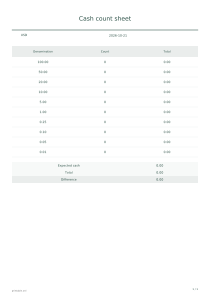
Choose six, twelve or twenty-four questions and use a variant number to recover the same set. All question sheets precede their answers. For a real cash-counting record, use the separate cash count sheet rather than a practice worksheet. This generator has no exchange rates, payment processing or financial advice; it supplies small arithmetic examples for learning.
Money worksheet generator
Count five US-dollar tokens
Choose USD, count the tokens, five tokens per question, six questions and variant 17 on A4 portrait. Enable answers. The PDF contains one question sheet and one answer sheet; each total is the sum of the five values printed inside that question’s circles.
Choose EUR, calculate the change, twelve questions and variant 31, with answers enabled. Each question provides a price and an amount paid. The document contains two exercise sheets followed by two answer sheets, with exact two-decimal currency amounts and no exchange-rate calculation.