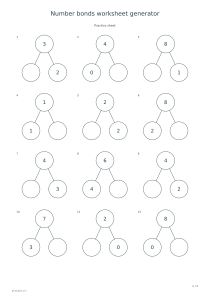
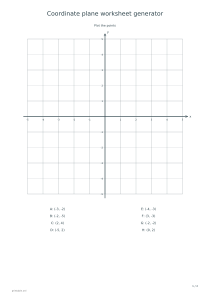
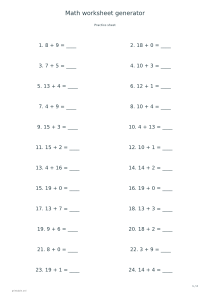
Make number bond worksheets with whole-and-part circles, missing values and optional answers. Choose a number range or fixed whole, then generate a reproducible set for addition and subtraction practice.
Live preview210 × 297 mm
A4
Preview is scaled to fit. The PDF keeps the exact dimensions.
PDF and Print include all pages. PNG and SVG save the page shown.
For true-size printing: choose 100% / Actual size, match the paper size and turn off headers and footers. Printing guide ↗
Ready for your printer
Number bonds make the relationship between a whole and its two parts visible. A child can count objects into two groups, write the parts in the lower circles and connect them to the total above. The same diagram also supports finding a missing addend or checking a subtraction.
💡A few useful answers
Can a part be zero?
Yes. A whole can be split into itself and zero. For example, a whole of eight may have parts eight and zero. This helps distinguish an empty group from a missing answer. The hidden circle is visibly blank, while a supplied zero is printed as the numeral 0.
Does mixed mode make the questions harder?
Mixed mode changes which circle is hidden, not the number range or a formally measured difficulty level. A missing whole calls for addition, while a missing part can be found through subtraction or counting on. Adjust the maximum and the number of diagrams separately to suit the learner.
Can I print questions without the answers?
Yes. Turn off the answer-sheet option before downloading or printing. With it enabled, the PDF contains the practice pages first and the filled pages afterwards. Check the preview selector when saving one PNG or SVG, since those formats export only the currently selected sheet.
Choose the whole and the missing value
🧩The upper circle contains the whole; the two lower circles contain parts whose sum equals it. In part mode, one lower circle is left empty. Whole mode hides the upper circle. Mixed mode alternates missing parts with some missing wholes, so the learner has to read the diagram before choosing the operation.
Set the maximum to 10, 20, 50 or 100. A fixed whole of zero means the whole varies from one to the maximum; zero is a setting code here, not a request for all-zero bonds. Enter a positive fixed whole to practise decompositions of that one number. Either part may itself be zero.
Connect diagrams to concrete arithmetic
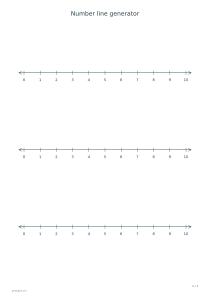
Start with counters, blocks or drawn marks if the numbers are not yet familiar. For a whole of ten and one part of four, move four counters aside and count the remaining six. Then connect the diagram to 4 + 6 = 10 and 10 − 4 = 6. A number line offers a different way to show the same missing distance.
Repeated whole-and-part combinations can occur because each problem is generated independently. This is useful for practice but does not guarantee every possible decomposition appears. The arrangement code reproduces the same set with the same settings. Change it for a new version, or keep it when preparing a matching answer sheet.
Build a manageable practice sequence
✏️Choose six, twelve or twenty-four diagrams. Portrait pages hold up to twelve; landscape pages hold up to six, with extra questions continuing on later sheets. The optional answer section follows the complete practice section and restores all three values. Use arithmetic worksheets when you want to move from these circle models to written equations.
Read a completed bond in both directions: two parts make a whole, and removing either part leaves the other. Ask the learner to explain one example rather than simply fill every blank. A hundreds chart can help locate larger totals, while the bond diagram keeps attention on the particular pair that belongs together.
Number bonds worksheet generator
Fixed whole (0 = varied): 10
For bonds to ten, choose maximum 10, fixed whole 10, missing part, twelve questions and arrangement code 11. Enable answers. Every upper circle contains ten; each visible lower value has exactly one complementary answer. This is a focused way to practise making ten before varying the whole.
For a mixed review, use maximum 20, fixed whole 0, mixed missing values, twenty-four questions and code 257. On A4 portrait the questions occupy two sheets and the answers occupy two more. The same settings reproduce the set, allowing a teacher to keep the matching key separately.