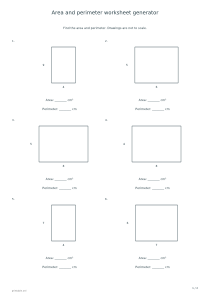
Generate printable area and perimeter worksheets with rectangles, squares, right triangles and L-shaped figures. Choose the units and include exact numerical answers.
Live preview210 × 297 mm
A4
Preview is scaled to fit. The PDF keeps the exact dimensions.
PDF and Print include all pages. PNG and SVG save the page shown.
For true-size printing: choose 100% / Actual size, match the paper size and turn off headers and footers. Printing guide ↗
Ready for your printer
Area measures the surface inside a boundary, while perimeter measures the distance around that boundary. These worksheets place both questions beside the same figure so that learners can compare the two ideas. Every shape includes the dimensions needed for calculation, and the answer sheet preserves the original drawing rather than replacing it with a disconnected list of numbers.
💡A few useful answers
Are the figures drawn to their labeled size?
No. The diagrams are scaled to fit their question spaces. A label of ten centimeters represents a mathematical length and does not mean the corresponding line prints ten centimeters long. All necessary values are written on the figure; calculate from those labels instead of measuring the drawing with a physical ruler.
Why can an L shape have the same perimeter as its outer rectangle?
This worksheet removes a rectangular corner. The two new inward edges have the same combined length as the two removed outer segments, so the perimeter remains twice the overall width plus twice the overall height. This property depends on the particular corner-cut shape; it is not a rule for every irregular or concave figure.
Does the triangle task require rounded square roots?
No. The right-triangle dimensions come from exact integer triples, including the hypotenuse. Area and perimeter can therefore be calculated without estimating a square root. The generator does not include arbitrary triangles, angle-based area formulas or curved boundaries in this version.
Separate the boundary from the surface
✏️Start with rectangles or squares when the distinction between area and perimeter is new. A rectangle with different side lengths helps show why multiplying two dimensions answers a different question from adding all four sides. The square option keeps both dimensions equal. Choose centimeters or meters for the stated lengths; the calculated area uses the corresponding square unit.
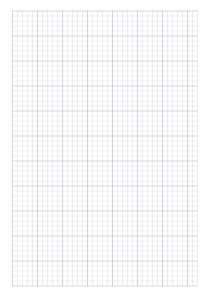
The drawings are schematic, not full-size measurement templates. Use the printed dimension labels to calculate, even if a figure looks a little wider or narrower on another paper format. For a separate activity in which learners draw and count unit squares, use printable graph paper. Do not treat a ruler measurement of this worksheet drawing as an additional given dimension.
Read the dimensions of each figure
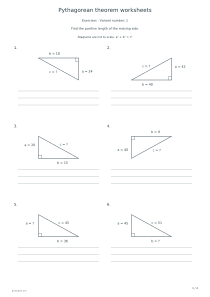
Right triangles use whole-number Pythagorean triples, so the two perpendicular legs and the hypotenuse give an exact perimeter. The area is half the product of the legs. The supplied lengths are sufficient; learners do not need to approximate the diagonal from its appearance. Follow with a Pythagorean theorem worksheet when calculating a missing side becomes the lesson’s main purpose.
An L-shaped figure is a rectangle with a rectangular corner removed. The overall width and height, together with the removed corner’s width and height, determine its area. Subtract the small rectangle’s area from the large rectangle’s area. The inner edges replace the removed outer segments, so the perimeter can also be checked against the original outer rectangle’s perimeter.
Compare methods and check the units
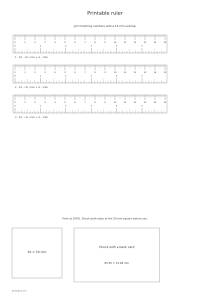
📝The range setting selects small whole-number dimensions up to ten or twenty within the supported shape families. Mixed mode cycles through rectangles, squares, right triangles and L shapes rather than assigning a difficulty score. If you want learners to practise measuring a real object afterward, provide an appropriate printable ruler and verify its physical scale before using it.
Six questions fit on each exercise sheet. Choose six, twelve or twenty-four questions and retain the variant number to reproduce the figures. Ask learners to write a formula, substitute the labeled dimensions and include units in the answer. When checking work, distinguish a wrong numerical calculation from confusing a linear perimeter unit with a square area unit.
Area and perimeter worksheet generator
A short rectangle practice sheet
Choose rectangles, range ten, centimeters, six questions and variant 17 on A4 portrait, with answers enabled. The PDF contains one question page and one answer page. Each rectangle asks for both area in square centimeters and perimeter in centimeters.
Choose mixed figures, range twenty, meters, twelve questions and variant 31, with answers enabled. The set contains three questions from each supported shape family. Two exercise pages are followed by two answer pages, allowing learners to compare the methods required for different boundaries.