Create a three-stage paper code trail with a reproducible seed and an optional host answer sheet. Solve missing numbers, follow a grid route and decode symbols to reach the final three-digit code.
Live preview210 × 297 mm
A4
Preview is scaled to fit. The PDF keeps the exact dimensions.
PDF and Print include all pages. PNG and SVG save the page shown.
For true-size printing: choose 100% / Actual size, match the paper size and turn off headers and footers. Printing guide ↗
Ready for your printer
This is a self-contained table activity made from three connected puzzle pages. The answer to one stage identifies the useful row on the next page. It does not require a physical lock, a phone, an online checker or outside factual knowledge. Keep the host key separate while players work.
💡A few useful answers
Do I need an actual lock or locked room?
No. The final code is a paper result that a host can check against the key. The editor does not configure physical locks, control doors or create a room layout. The three pages work as a seated activity with writing materials.
What if the grid route seems to leave the page?
Check the first code, the chosen lookup row and the marked centre starting point. The intended four-move route stays inside the five-by-five grid. Read the digit after moving, rather than counting the starting cell as the first digit.
Can players skip ahead by inspecting the tables?
All clues are visible on paper, so the activity relies on following the stated sequence. It is not an access-control system. A host can distribute one stage at a time if discovering the next page is part of the group experience.
Prepare the three pages in sequence
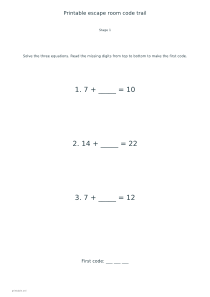
✏️Stage one gives three missing-addend equations. Solve each blank and read the resulting digits from top to bottom. Their order matters: a correct set of digits in a different order is a different code. Leave the equations visible so players can check a doubtful result, rather than treating a transcription mistake as a new riddle that needs an invented explanation.
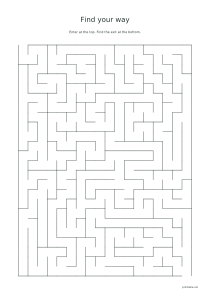
The first code appears exactly once in the second page’s lookup table. Its row gives four directional moves. Start from the marked centre of the five-by-five grid and read the digit reached after each move, producing the next code. The intended route remains inside the grid. A printable maze provides a separate route-following exercise if that convention needs a warm-up.
Follow each code through the next puzzle
Stage three has another table, this time indexed by four-digit codes. Find the row matching the route result and read its three symbols in order. The printed symbol key maps each shape to a digit. Those three digits are the final code. No symbol needs a cultural interpretation or a guessed letter name: all information needed to decode it is on the sheet.
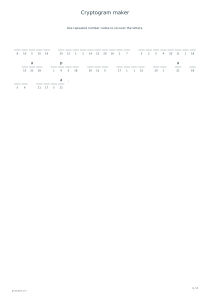
The stages use different representations of the same idea: calculate information, select a matching record and translate a sequence. Invite players to explain why their chosen table row matches before moving on. For an additional substitution activity outside this trail, the cryptogram maker encodes your own text; it is a separate puzzle with its own key.
Review the solution as a host
📝The variant seed controls the equations, grid digits, route and lookup tables together. Reusing the complete settings recreates the same linked set. Mixing pages from two seeds will generally break the trail, so a short shared title is useful when preparing several groups. The generated activity has no promised age band, completion time or calibrated difficulty rating; review a sample for the actual players.
The host key lists the completed arithmetic, both intermediate codes, the route directions and the final result. It is a fourth page, not an instruction to cut up or hide the puzzle sheets. Decide how much help to offer: point to the relevant equation, then the matching row, before revealing a whole code. Arithmetic practice sheets can address a specific calculation gap separately.
Printable escape room code trail
A complete hosted trail
Use seed 17 with answers enabled. Print the three puzzle pages for players and retain page four as the host key. Check the first arithmetic code, then the route code, before using the final symbol result to finish the activity.
Use seed 31 and disable answers. The PDF contains exactly three stages. Keep that seed and the other settings if you later need the host sheet; do not combine an answer page from another variant with this set.