Turn a sentence into a number-code puzzle. Preserve its spacing and punctuation, reveal a few letter mappings when helpful and print an optional completed answer page.
Live preview210 × 297 mm
A4
Preview is scaled to fit. The PDF keeps the exact dimensions.
PDF and Print include all pages. PNG and SVG save the page shown.
For true-size printing: choose 100% / Actual size, match the paper size and turn off headers and footers. Printing guide ↗
Ready for your printer
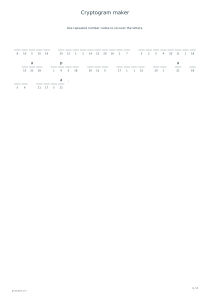
A cryptogram hides letters behind numbers while giving every occurrence of the same exact letter form the same code. Learners notice repetition, combine clues and gradually recover the text. Choose a natural sentence your audience can understand before encoding it. The editor does not analyze meaning or consult a dictionary. Familiar vocabulary can support inference, while unusual names may make a puzzle harder without adding a useful learning step.
💡A few useful answers
Why do uppercase and lowercase versions have different codes?
The mapping distinguishes the exact form entered. Capital A and lowercase a are separate units. Explain that convention before solving, or deliberately prepare consistent capitalization. The editor does not silently convert the text to one case or remove its accents.
What do two revealed mappings actually show?
They reveal up to two distinct connections between a letter form and its number. Each connection may solve several cells when the code repeats. They do not necessarily solve two words. Start by finding every occurrence of a revealed number before guessing another letter.
Is a shared cryptogram safe for confidential text?
No. Explicit sharing publishes the supplied text and settings, and the optional answer page displays the complete message. The code is a puzzle mechanic rather than secure communication. Use an original everyday sentence you intend to make public when sharing an example.
Choose a clear source sentence
✏️Enter up to 240 visible characters, using at least four letters and no more than sixty distinct letter forms. Digits, spaces and punctuation stay visible rather than becoming extra coded letters. Line breaks are treated as spaces, and cells wrap to fit the available width. Read the source as continuous text before generating it. A native-language sample is available when you want a starting sentence instead of entering your own.
Every distinct exact letter cluster receives one unique integer from one through the number of distinct forms. The mapping works both ways: different letter forms never share a code. Uppercase and lowercase count separately, so an initial capital need not have the same number as its lowercase form later. Existing combining marks stay with their letter cluster. This is a written-character model, not automatic analysis of every language's sounds, digraphs or spelling conventions.
Track repeated letter codes
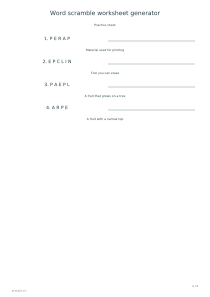
The arrangement code shuffles the number assignments. Keeping the same source and code recreates the puzzle. Changing the code does not translate the sentence or rearrange its words. For a different activity that moves known letters into order, use a word scramble worksheet. In a cryptogram, the positions are retained; the unknown is which letter belongs to each repeated number and whether a proposed substitution remains consistent everywhere.
Choose zero, two or four revealed mappings. This means up to that many distinct letter-number pairs, not that many complete solved words. One revealed mapping can help in several places when its code repeats. Find those positions first, then inspect surrounding characters and word lengths. Test a possible substitution across the whole message: a letter that seems plausible in one word can create a contradiction elsewhere and show that the guess needs revision.
Test each proposed mapping throughout the text
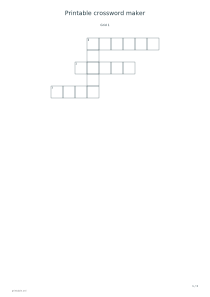
📝A crossword maker provides a different way to connect definitions and intersecting words. Here the pattern of the supplied message provides the clues. The generator does not score linguistic difficulty or guarantee that every short text supports a unique path of human deduction. If learners cannot begin, discuss a familiar word or reveal more mappings. The aim is consistent substitution, not simply guessing a sentence after someone reads it aloud.
The output is one puzzle and an optional completed answer page. After solving, check capitals, accents and the complete transcription. Use spelling worksheets for additional practice with selected words. PDF and Print include both enabled pages; PNG, SVG and Share use the selected preview. Explicit Share saves entered text publicly. A coded-looking puzzle is therefore not protection for a secret message or personal information, even when its answer page is not the selected preview.
Cryptogram maker
A sample message with two mappings
Load the native sample sentence, choose two revealed mappings, arrangement code 17 and answers enabled. You receive a puzzle page and its completed solution. Find all occurrences of the revealed codes first, then test new substitutions for consistency across the rest of the message.
Use the native sample, choose zero revealed mappings and arrangement code 31, keeping answers enabled. Spaces, punctuation and digits remain visible, but no letter mappings are supplied at the start. Set the solution aside until the attempt is complete, then check capitalization as well as the recovered words.