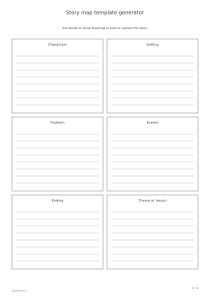
Print a story organizer with six labeled sections or a sequence of event boxes. Choose writing lines, use your own map headings and make a blank worksheet for planning a story or discussing one you have read.
Live preview210 × 297 mm
A4
Preview is scaled to fit. The PDF keeps the exact dimensions.
PDF and Print include all pages. PNG and SVG save the page shown.
For true-size printing: choose 100% / Actual size, match the paper size and turn off headers and footers. Printing guide ↗
Ready for your printer
A story map gives a discussion somewhere to land. It can help a reader separate who is involved, where events happen, what changes and how the ending relates to the problem. The editor creates the empty structure for that work; the reader or writer supplies the ideas, evidence and connections.
💡A few useful answers
Does the generator create a story from my title?
No. The title labels the sheet, and the rest of the organizer stays blank for handwriting or drawing. There is no story-writing model, reading comprehension analysis or automatically generated plot, even when the standard headings suggest a narrative structure.
Can custom labels change the sequence layout?
Custom headings belong to the six-part map. The sequence layout keeps its native characters, setting, numbered event and ending labels. Switch back to the map to use the six labels you entered; they do not silently replace the event headings.
Is every box supposed to contain the same amount of writing?
No. Some stories need a detailed explanation of the problem and only a short setting note, while others invite a different emphasis. Choose concise evidence and leave space where it helps. The organizer is a guide for thinking rather than a requirement to produce equal-length answers.
Choose between a story map and a timeline
✏️The six-part map has boxes for characters, setting, problem, events, ending and theme or lesson. Use the standard headings for a familiar narrative task, or replace all six with short custom labels. A lesson plan template can hold the teaching objective and discussion sequence separately, leaving the learner’s story map focused on the text rather than crowded with lesson administration.
Custom headings apply to the six-part map only. Enter one heading per line, with six headings in total and a maximum of twenty-four characters each. This makes it possible to organize another reading question without pretending the generator has interpreted the story for you. Check that the labels ask for different kinds of information rather than repeating the same prompt in six boxes.
Adapt headings to the reading task
The event-sequence layout starts with characters and setting, continues through three or five event boxes and ends with a space for the ending. It emphasizes order instead of the six-part map’s separate problem and theme sections. The event count determines the number of blank steps, not the number of events the generator has found in a book. Choose a level of summary appropriate to the story.
Writing lines can support brief notes, while unruled boxes leave more freedom for arrows and small drawings. A comic strip or storyboard template is a better next step when pictures and panel composition become the main task. The story map remains a planning and reflection sheet, with space for ideas rather than speech balloons or an automatically illustrated narrative.
Leave room for evidence and revision
📝Ask for a specific detail before a broad conclusion. A character’s action, a setting clue or a change near the ending gives the learner something to point to when explaining an interpretation. There is no answer key because the worksheet contains no story text and does not make a claim about the right interpretation. Different readers may select different evidence and still support a useful discussion.
Keep notes concise enough to see relationships across the page. If a box becomes a draft paragraph, continue on lined writing paper instead of shrinking handwriting into the remaining space. Return to the organizer after drafting or rereading and revise a heading or note when the evidence changes. The value comes from making the reasoning visible, not from filling every box equally.
Story map template generator
A ruled six-part reading map
Choose Six-part story map and enable writing lines on portrait A4. Leave custom headings blank to use characters, setting, problem, events, ending and theme. The result is one organizer page for short notes about a story already selected by the reader.
Select Event sequence, five event boxes and no writing lines, then use A4 landscape. One page includes characters and setting, the five numbered event spaces and an ending box. Use brief notes or small sketches to show the order of the chosen story.