Turn your own sentences into shuffled word cards and writing lines. Set word boundaries with spaces or vertical bars, use a native-language sample set, and print an optional key that preserves the order you supplied.
Live preview210 × 297 mm
A4
Preview is scaled to fit. The PDF keeps the exact dimensions.
PDF and Print include all pages. PNG and SVG save the page shown.
For true-size printing: choose 100% / Actual size, match the paper size and turn off headers and footers. Printing guide ↗
Ready for your printer
Begin with sentences a learner can understand when read aloud. The activity asks them to rebuild an existing sentence from its parts; it does not choose vocabulary, correct grammar or decide whether another word order is also acceptable. Review the source text first, then use the shuffled cards to focus attention on order, capitalization and punctuation.
💡A few useful answers
How do I enter a sentence without spaces between its words?
Insert a vertical bar between the cards you want the learner to rearrange. The bar is an input separator and is not printed as part of a card. Choose meaningful units yourself; the editor does not automatically analyze grammar or infer word boundaries.
Does the editor correct a misspelled or ungrammatical sentence?
No. It preserves your supplied text and order as the answer. Check the source before printing, including punctuation and repeated words. The worksheet is a rearrangement activity, so an error in the original sentence remains an error in the generated key.
Why can another card order also make sense?
Language often permits more than one valid arrangement, especially when short phrases can move within a sentence. The answer page records the author’s intended order rather than proving uniqueness. Use alternate solutions as a chance to compare meaning, emphasis or punctuation.
Define the word cards you want to teach
✏️Enter one sentence per line, from one to eight sentences in a set. Each sentence needs three to twelve cards, with at most twenty-four text characters per card. Use spaces for a simple word-by-word split, or insert vertical bars exactly where you want the boundaries. The latter option lets you keep a short phrase together or split a sentence whose writing system normally does not place spaces between every word.
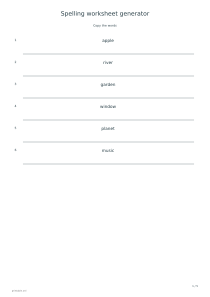
Punctuation remains attached to the card on which you enter it. A final full stop can therefore help identify the last card, and an initial capital can suggest the beginning. Those clues may be useful support rather than something to remove automatically. For a related activity that concentrates on the spelling of individual words, prepare a custom spelling worksheet from the same vocabulary.
Keep punctuation and sentence order visible
The native sample button supplies four short example sentences for the selected interface language. It replaces the current sentence field with that example set, so preserve any custom source text you want to reuse before selecting it. The samples are starting points for a discussion, not a claim that the same sentence length or vocabulary represents an equivalent reading level in every language.
The arrangement code shuffles the supplied cards deterministically. It changes card order while preserving their text, punctuation and capitalization. When the sentence has more than one distinct card, the generator avoids leaving the whole sequence in its original order. Repeated words can still appear, and they are not removed merely to make the puzzle visually simpler.
Adapt the activity to different writing systems
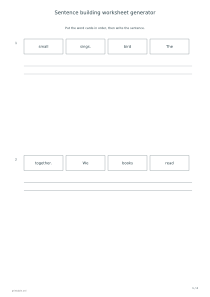
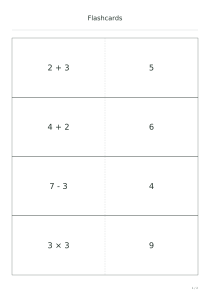
📝Two sentences occupy each exercise page, with card outlines and blank writing lines. Learners can number the cards, point to them in order or cut them out if that suits the lesson. If reusable question-and-answer pieces are more useful than a complete worksheet, try foldable flashcards as a separate format. Here the card set belongs to its source sentence and should remain grouped with it.
The key reproduces the order you supplied rather than running a grammar checker. Another sequence may also be grammatical or express a different meaning, so discuss the result instead of treating every difference as an error. A handwriting practice sheet can provide extra space after reconstruction. For languages without regular spaces, compare the explicit card boundaries with the way the complete sentence is normally written.
Sentence building worksheet generator
Rebuild four sample sentences
Load the native sample set, keep arrangement code 17 and enable answers on portrait A4. The four sentences produce two exercise pages followed by two pages showing their original order. Each practice section includes shuffled cards and room to write the reconstructed sentence.
Use the same four-sentence native sample, select arrangement code 31 and turn answers off. Portrait A4 produces two practice pages. The sentence text remains unchanged while the card order differs, making this a repeat activity with familiar vocabulary.