Create grid patterns to reflect across a vertical or horizontal axis. Choose grid size, pattern type and question count, then add exact mirrored answers for checking the completed cells.
Live preview210 × 297 mm
A4
Preview is scaled to fit. The PDF keeps the exact dimensions.
PDF and Print include all pages. PNG and SVG save the page shown.
For true-size printing: choose 100% / Actual size, match the paper size and turn off headers and footers. Printing guide ↗
Ready for your printer
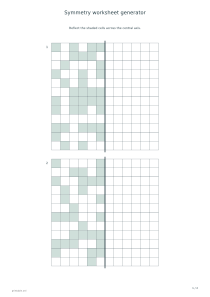
Reflection gives each shaded cell a matching cell on the opposite side of an axis at the same distance. The task is more precise than drawing something that looks similar. A grid makes positions countable, and the central line separates the supplied half from the half to complete. Begin with one cell near the axis and explain its partner before moving to a larger pattern with gaps and disconnected parts.
💡A few useful answers
Does the axis go through shaded squares?
The axis follows the central boundary between cells, not their centers. Every supplied cell therefore has a separate partner in the other half. Locate the correct line before counting distances. Starting from a neighboring grid line can shift the entire answer even when the pattern otherwise looks similar.
Should I connect separate pieces of the pattern?
No. Disconnected groups and empty cells are part of the supplied design. Reflect each shaded square and preserve the gaps. Adding new cells to make a continuous or prettier shape changes the task, even if the finished drawing looks orderly at first glance.
Is reflection the same as turning the pattern around?
No. Reflection transfers positions across a line at equal distances, while rotation turns them around a point. This worksheet asks for reflection only. Use one distinctive corner or isolated cell to show why a rotated version does not match the required partners across the axis.
Locate the axis between central cells
✏️Choose a grid with eight, twelve or sixteen cells along each edge. A vertical axis lies between the central columns; a horizontal axis lies between the central rows. It does not pass through cell centers. The given pattern is on the left for a vertical axis and above for a horizontal one. Identify the supplied and unfinished halves first, avoiding accidental changes to both sides before the reflection rule is understood.
Across a vertical axis, the row stays the same and the column position is mirrored. Across a horizontal axis, the column stays the same and the row changes. Count outward from the axis rather than inward from the paper edge. The nearest cell has the nearest partner. Use graph paper for a separate introductory example with only a few pairs before asking learners to track several parts of a more detailed pattern.
Reflect positions without rotating
Mosaic, Steps and Diamond provide original shaded-cell patterns, with the arrangement code determining the generated set. A pattern can contain disconnected cells rather than one continuous silhouette. Do not join separate pieces simply to make the drawing look complete. Reflection preserves empty gaps as well as occupied cells. The space between groups can be just as important as the shaded squares, so include both in the final check of the learner's work.
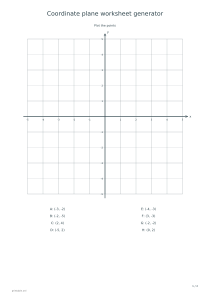
Each task uses one reflection across the chosen central axis. There are no diagonal axes, rotations or drawing uploads. Coordinate plane worksheets can provide a later language for describing positions, but row, column and distance from the axis are enough here. Turning the paper to look at it is not the same as rotating the pattern into a new position. The latter produces a different transformation rather than the required reflected pairs.
Check shaded cells and empty spaces
📝Choose two, four or eight questions, with two grids per exercise page. Grid size means a cell count, not a guaranteed physical square size in millimetres. Paper and orientation affect the available writing area. Check that a learner can shade cells without crossing their boundaries. Mandala coloring pages offer a separate activity with repeating decoration, while this worksheet keeps the specific goal of reproducing the exact reflected positions of the supplied cells.
Optional keys contain the exact mirrored occupied cells and follow all practice pages. Compare pairs rather than relying on the overall impression of the finished picture. Inspect the row or column immediately beside the axis, where a one-cell shift can affect the rest of the reflection. PDF and Print include the complete set; PNG, SVG and Share use the selected preview. The editor does not read handwritten shading, so identifying and discussing mistakes remains a human checking task.
Symmetry worksheet generator
Two mosaics with a vertical axis
Choose grid size 12, Vertical, Mosaic, two questions and arrangement code 17. Enable answers. The two-page output contains a page with two grids and a page with their reflections. Complete the right half, preserving each cell's row and its distance from the central axis.
Choose grid size 16, Horizontal, Steps, four questions and arrangement code 31, keeping answers enabled. Two exercise pages are followed by two key pages, making four altogether. Reflect into the lower half while preserving the column of each supplied cell and finding its matching row.