Make printable nonogram puzzles from original geometric pictures, a seeded pattern or your own binary grid. Choose five, ten or fifteen cells per side and include a separate answer sheet when useful.
Live preview210 × 297 mm
A4
Preview is scaled to fit. The PDF keeps the exact dimensions.
PDF and Print include all pages. PNG and SVG save the page shown.
For true-size printing: choose 100% / Actual size, match the paper size and turn off headers and footers. Printing guide ↗
Ready for your printer
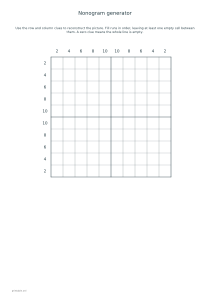
A nonogram turns a hidden picture into ordered run clues. A row marked 2, 3 contains two filled cells followed later by three filled cells, with at least one empty cell between the groups. The same rule applies down each column. Read both directions together: neither clue list alone describes the whole picture.
💡A few useful answers
Can I use a photograph as a nonogram?
This editor accepts binary grid rows, not photo uploads. Reduce your idea to occupied and empty squares yourself, then enter the rows. A small silhouette usually communicates more clearly than a detailed scene at fifteen cells per side.
Why was my custom picture rejected?
Different pictures can share the same run clues. The editor rejects a custom grid when the clues admit more than one solution, and separately reports a verification limit. Change a few cells or use a smaller picture before trying again.
Will the answer show my exact drawing?
Yes. A valid custom bitmap has exactly one solution from its printed clues, so the completed grid on the answer page matches the submitted occupied cells. The clue order follows the picture from left to right and top to bottom.
Choose a picture and a workable grid
✏️The five-cell grid is a compact introduction to crossing row and column information. Ten cells provide more room for a recognizable geometric image, while fifteen cells produce a denser sheet with longer clue lists. A larger grid is not automatically harder. The number and arrangement of runs matter more than the area alone, so review the actual puzzle before choosing it for a learner.
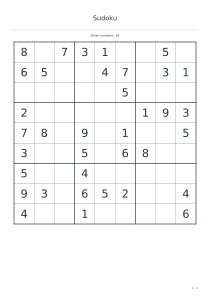
Diamond, house and tree are original binary patterns. The seeded picture option creates another arrangement from the variant number, and the same settings reproduce it. The generator retries pictures that do not pass its uniqueness check; a geometric fallback can be used when required. This makes the seed a reproducible identifier, not a certified difficulty level. For another number-grid activity, try printable Sudoku.
Read the clues without guessing the artwork
Begin with a line whose runs occupy most of the available cells. Count the required spaces as well as the filled runs. A clue of zero means every cell in that line is empty. Pencil marks for confirmed empty cells help distinguish a deliberate gap from an undecided square. The printed grid has stronger boundaries every five cells, which can help keep long rows aligned.
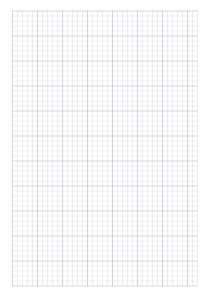
Cross-check a deduction against the perpendicular clues before filling a large area. The picture is a result of the clues, not a substitute for solving them: recognizing a roof is not proof that its next cell is occupied. If someone needs a separate place to test a line, a sheet of graph paper provides matching square space without revealing the final pattern.
Make and check your own nonogram
📝Custom mode accepts one line of zeros and ones for each row. Enter exactly as many rows and digits per row as the selected grid size. A one fills a cell and a zero leaves it empty. Spaces, separators and extra rows do not belong in the bitmap. Start with a small drawing, check the preview, then revise the actual digits rather than assuming the tool will crop or resize it.
An exact bounded solver checks whether the row and column clues determine one solution. Ambiguous custom pictures are rejected, and a picture that exceeds the verification limit must be simplified. This is a uniqueness check, not a promise that a particular deduction method will solve the puzzle easily. For a drawing exercise with a different rule, compare the reflection worksheets.
Nonogram generator
A ten-cell diamond
Select ten cells, the diamond pattern, variant 17 and answers. The result has one puzzle page and one completed grid. Keep the answer sheet separate and use the strong five-cell boundaries when discussing deductions across the centre.
Select five cells, seeded picture, variant 31 and turn answers off. The one-page result is a short clue-reading activity. Record the variant and other settings if you want to recreate the exact worksheet for a later review.