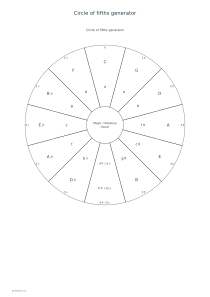
Make a printable circle of fifths as a complete reference, a missing-name exercise or a blank template. Include relative minors and key-signature counts, choose a physical diameter and add restrained sector colors.
Live preview210 × 297 mm
A4
Preview is scaled to fit. The PDF keeps the exact dimensions.
PDF and Print include all pages. PNG and SVG save the page shown.
For true-size printing: choose 100% / Actual size, match the paper size and turn off headers and footers. Printing guide ↗
Ready for your printer
The twelve positions move clockwise by perfect fifths, starting with C at the top. The chart uses international letter names and pairs major keys with their relative natural minor keys. It is a compact key-signature reference, not an audio tool or an automatic chord-progression composer.
💡A few useful answers
Why do F-sharp and G-flat share a position?
The twelve-position reference uses a shared enharmonic location at six sharps or six flats. Both names and signature counts remain visible so their written distinction is preserved. The chart is not a catalogue of every theoretical key spelling.
Does the inner ring show a major key’s parallel minor?
No. It shows the relative minor, which shares the signature. C major therefore pairs with A minor, not C minor. A parallel minor has the same tonic letter but generally a different signature and is not the relationship shown here.
Will blank mode also print an answer?
Blank mode is an open template and omits the key. Use practice mode with answers when you want missing names followed by the completed reference. A complete reference already contains its labels and therefore needs only one page.
Read the clockwise order and signature counts
✏️The clockwise major sequence is C, G, D, A, E, B, F-sharp/G-flat, D-flat, A-flat, E-flat, B-flat and F. The shared six-sign position shows both enharmonic names. Following the sharp side adds a sharp to the key signature at each step; following the flat side in the other direction adds a flat. The chart makes that count visible when the signature option is enabled.
The six-sign position is labelled with six sharps or six flats, according to the spelling selected in the paired name. These are different written signatures, even though the keys share a position in this twelve-part diagram. The chart does not show every possible theoretical spelling. Use blank music paper if you want to write the actual order and staff positions of the signature symbols.
Use the paired minor names deliberately
Relative minor keys share the displayed major key’s signature. For example, C major pairs with A minor, and G major pairs with E minor. The minor names sit on an inner ring and use lower-case lettering to distinguish their role. This reference does not spell harmonic or melodic minor scales, which can alter notes beyond the shared key signature.
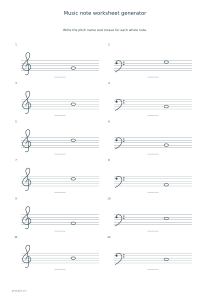
International B means B natural, while B-flat is explicitly marked. In naming systems that call B natural H, translate that convention consciously rather than reading the unmodified B label as B-flat. The note-reading worksheets use the same international convention and can help establish the difference between a pitch name and a key-signature relationship.
Turn the reference into a writing exercise
📝Reference mode fills the names. Practice mode leaves the major and, when selected, relative minor names empty; its optional answer page restores them. Blank mode removes names and signature counts, giving a clean structure for an exercise you choose yourself, and does not add a key. The show-minor and show-signatures choices let you focus on one relationship at a time.
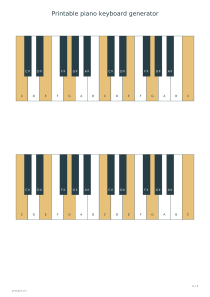
Diameter is a physical measurement, with 140, 160 and 180 mm options. If a selected circle does not fit, use larger paper or reduce the diameter; the generator does not silently compress it. Colors separate sectors without assigning emotional or harmonic meaning to a hue. A keyboard template provides another way to explore the named pitches alongside the circle.
Circle of fifths generator
A colored reference circle
Select reference mode, 160 mm diameter, relative minors, signature counts and colored sectors. The single page shows the complete twelve-position chart. Read the paired six-sign label carefully and use the colors only as visual separation.
Select practice mode, 140 mm diameter, relative minors and signature counts; turn sector colors off and answers on. The first page leaves key names empty, while the second restores them. The displayed signature counts provide clues for checking the order.