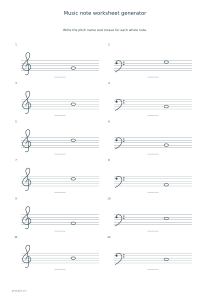
Create natural-note exercises in treble clef, bass clef or both. Read printed whole notes or draw the requested pitch, choose staff-only or ledger-line ranges and include a separate answer set.
Live preview210 × 297 mm
A4
Preview is scaled to fit. The PDF keeps the exact dimensions.
PDF and Print include all pages. PNG and SVG save the page shown.
For true-size printing: choose 100% / Actual size, match the paper size and turn off headers and footers. Printing guide ↗
Ready for your printer
These sheets practise pitch position rather than rhythm. Every task uses a natural pitch and a scientific octave number, with no key signature or accidental. The answer format can use international letters A–G or fixed Do–Re–Mi syllables. Clef and octave together determine the exact requested note.
💡A few useful answers
Are these rhythm worksheets?
No. The whole-note head is a consistent way to show pitch position. The editor does not ask about duration, metre, rests or rhythmic counting, and it does not generate musical passages. Keep rhythm practice as a separate activity.
Why does the same letter have different octave numbers?
Letter names repeat in each octave, while the number identifies a particular pitch register. The scientific convention advances at C: B3 is followed by C4. Use the displayed number when drawing a requested note above or below another occurrence of that letter.
Can I add sharps, flats or key signatures?
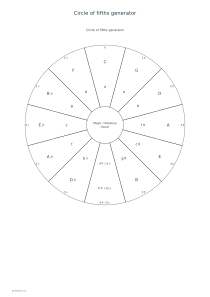
The current exercises use natural pitches only. Treble and bass clefs change the mapping between positions and notes, but no key signature modifies the answer. The circle-of-fifths tool provides a separate reference for signature counts.
Choose a clef and a controlled pitch range
✏️In treble clef, the staff-only range runs from E4 on the bottom line to F5 on the top line. In bass clef it runs from G2 to A3. Mixed mode alternates the two clefs, so students must inspect the symbol at the beginning of each small staff. A note at the same vertical position can have a different name when the clef changes.
The ledger option extends treble practice from C4 through A5 and bass practice from E2 through C4. Notes beyond the five staff lines receive the short ledger lines they need. Use blank staff paper for a slower explanation of how line and space positions continue outside the staff before assigning a dense set of identification exercises.
Connect a notehead with its name
Reading mode prints a whole-note head and leaves room for its name. Drawing mode prints the requested pitch and an empty staff, inviting the learner to place a whole note. The answer pages complete the same tasks instead of introducing a different sequence. A whole-note shape is used consistently to keep the task about pitch; there are no rhythm calculations, stems or rests to decode.
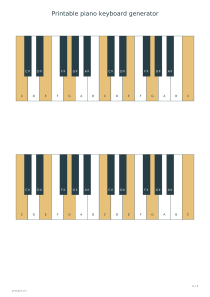
International letter names use B for B natural. That differs from the B/H convention used in some countries, so make the naming system explicit before marking answers. Fixed Do here maps C, D, E, F, G, A, B to Do, Re, Mi, Fa, Sol, La, Si. The printable piano keyboard can help connect those names with a physical sequence of keys.
Use reading and drawing as separate tasks
📝The scientific octave number changes at C. Middle C is C4, and B3 sits immediately below it. Include the octave in an answer when the exercise asks for a specific pitch rather than only a letter class. The worksheet does not infer a learner’s preferred regional octave convention, transpose instrument parts or turn fixed Do into a movable-Do system.
Twelve exercises fit each worksheet page. Choose twelve, twenty-four or forty-eight tasks and a seed to reproduce the note sequence. A new variant changes the selected pitches without asserting a new difficulty level. Once pitch naming is comfortable, the circle of fifths introduces a separate relationship between key signatures and relative keys; it is not needed to answer these natural-note tasks.
Music note worksheet generator
Read both clefs on the staff
Choose mixed clefs, read-notes mode, staff-only range, letter names, twelve tasks and seed 17. Enable answers for one worksheet plus one key. Ask the learner to name each clef before identifying its pitch and octave.
Choose treble clef, draw-notes mode, ledger range, fixed solfege, twenty-four tasks and seed 31. With answers enabled, two worksheets are followed by two keys. Check both the notehead position and the short ledger lines when reviewing a drawing.