Create percentage exercises for finding an amount, a whole, a rate or a signed change. Choose a number set, keep a reproducible seed and print a separate worked answer key.
Live preview210 × 297 mm
A4
Preview is scaled to fit. The PDF keeps the exact dimensions.
PDF and Print include all pages. PNG and SVG save the page shown.
For true-size printing: choose 100% / Actual size, match the paper size and turn off headers and footers. Printing guide ↗
Ready for your printer
Pick one problem type for focused practice or select Mixed tasks to cycle through all four types. The generator chooses compatible inputs so every requested answer is a whole number. This makes the relationship between the quantities the main challenge, without introducing an unstated rounding rule. Select six, twelve or twenty-four questions and use the preview selector to inspect both tasks and optional answer sheets.
💡A few useful answers
Will I need a rounding rule?
The generated inputs are chosen to produce exact whole-number answers for the requested quantity. There is no hidden instruction to round to a decimal place. The answer key shows the arithmetic used to obtain that exact result.
Can a percentage-change answer be negative?
Yes. A decrease is represented by a negative percentage, while an increase uses a positive percentage. The calculation always divides the difference by the original starting amount, so reversing the comparison is a different question.
Does changing the seed alter the difficulty setting?
No. The seed selects a reproducible set of numbers inside the chosen configuration. The task mode, easy or standard number set, count and answer setting stay as you selected them. Keep all those settings when sharing a matching worksheet.
Identify which quantity is missing
✏️Find a percentage of a number supplies the whole and the percentage, leaving the resulting part blank. The calculation multiplies the whole by the percentage and divides by one hundred. Find the whole reverses that relationship: the part and percentage are given, and the learner must recover the original total. Reading the sentence carefully matters because the same two visible numbers can invite a familiar calculation that answers the wrong question.
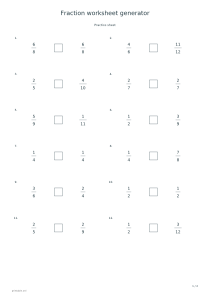
Find the percentage gives a part and a whole. Dividing the part by the whole and multiplying by one hundred produces the requested rate. It can help to sketch the relationship as a fraction before calculating. The fraction worksheet generator provides separate practice with fraction operations, while this editor concentrates on percentage relationships. A whole-number answer here does not mean that all real-world percentage questions have whole-number results.
Distinguish a rate from a change
Percentage change compares an ending amount with a starting amount. Subtract the start from the end, divide by the starting amount and multiply by one hundred. An increase has a positive answer and a decrease a negative answer. The starting amount remains the denominator even when the final amount is smaller. These are changes in quantities, not changes between two percentage rates, so a percentage-point interpretation is not part of the task.
The easy number set uses percentages in multiples of ten. Standard also includes values such as five, twenty-five and seventy-five percent. The generator selects compatible wholes rather than asking the learner to round a decimal answer. Mixed mode cycles through the four question types, making it useful after each individual method is familiar. The seed changes the chosen values while preserving the selected task type, number set and question count.
Check the method as well as the answer
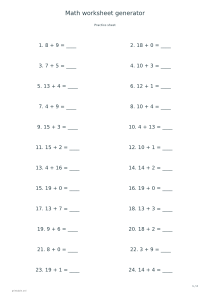
📝Answer sheets include a short numerical working for every question. Compare the method as well as the final value: a correct number obtained by guessing does not demonstrate the inverse calculation needed to find a whole. Keep the key separate while learners work, then discuss a few contrasting questions. The arithmetic worksheet editor can supply additional multiplication or division practice when those calculations are the part slowing the learner down.
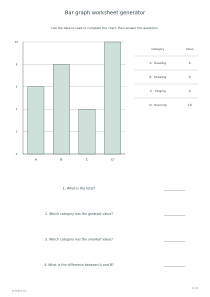
Twelve questions fit on each task sheet, and twenty-four questions produce two task sheets before their keys. Six questions leave unused space for extra workings. A4, A3 and US Letter, portrait or landscape, use the same mathematical inputs. PDF and Print include the set; SVG and PNG use the selected page. After numerical practice, data graph worksheets offer another way to discuss parts and comparisons using visible quantities.
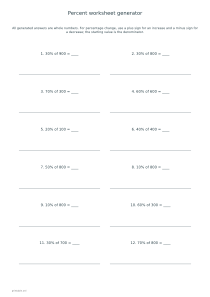
Percent worksheet generator
Twelve percentage-of-an-amount questions
Select Find a percentage of a number, the easy number set, twelve questions and seed 17. Enable answers on A4 portrait. The export contains one question sheet followed by one key with multiplication-and-division workings.
Choose Mixed tasks, Standard, twenty-four questions and seed 31, with answers enabled. A4 portrait produces two task pages and two answer pages. The four types repeat in order, including signed percentage changes as well as missing parts, wholes and rates.