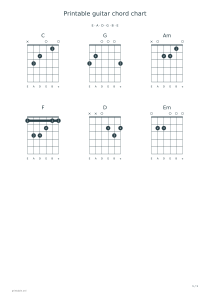
Build a ukulele chord sheet with four-string diagrams, finger numbers, barres and left-handed layouts. Choose high-G or low-G tuning, arrange supported chords or print blank diagrams for your own notes.
Live preview210 × 297 mm
A4
Preview is scaled to fit. The PDF keeps the exact dimensions.
PDF and Print include all pages. PNG and SVG save the page shown.
For true-size printing: choose 100% / Actual size, match the paper size and turn off headers and footers. Printing guide ↗
Ready for your printer
Keep the chord shapes for a practice session together instead of searching through a large reference book. A short ordered list is useful for learning transitions or writing a song’s progression. The printable shows a selected fingering for each supported chord, not every possible voicing or a complete song arrangement.
💡A few useful answers
Will these charts work for a baritone ukulele?
Only if it is actually tuned to the displayed G–C–E–A pitches. A baritone in D–G–B–E needs different pitch interpretation, so these named shapes should not be treated as a baritone chord reference. Select the chart according to the tuning on the instrument, not only its size or name.
Why are the finger numbers the same for high G and low G?
Both tunings use the same pitch classes on each string. Lowering G by an octave changes the register but not which fret supplies a given pitch class, so the selected chord fingering remains usable. The resulting voicing can sound different, especially when an open G becomes the lowest note.
Can I enter any chord symbol?
The named-chart mode accepts the sixteen shapes listed beside its input. An unsupported symbol is rejected instead of being guessed. Use blank diagrams for another chord, an alternative fingering or a different tuning, and write the details yourself. Blank mode does not validate what you later draw on the page.
Read a four-string chord diagram
🎵The diagrams use G–C–E–A string order. High-G tuning is G4–C4–E4–A4; low-G changes the first string to G3. The remaining pitches stay the same, so the printed fret shapes have the same chord names in both tunings. Their sound and lowest note can differ because one string has moved by an octave.
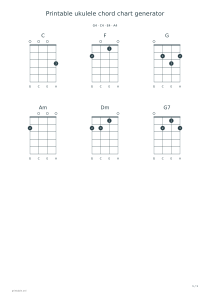
A circle above the nut marks an open string, and a filled dot marks a fretted note. When finger numbers are enabled, 1 is the index finger, 2 the middle, 3 the ring and 4 the little finger. A thick connecting mark represents a barre. The diagrams show five frets and use shapes within that displayed range.
Choose tuning and useful chord groups
Enter supported chord names separated by commas. Their order and repetitions are preserved, allowing a list such as C,F,G,C to show a simple progression. Available shapes include major, minor and seventh chords listed beside the input. If you are starting on six strings instead, use the guitar chord generator, whose tuning and diagrams are different.
Left-handed mode mirrors the diagram and its string labels together; it does not change the underlying pitches or chord name. Use the string labels to orient yourself rather than assuming the leftmost line always represents the same physical string. Blank mode prints six, twelve or twenty-four empty four-string grids for your own shapes and chord labels.
Practise changes with a clear reference
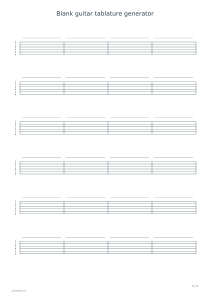
✏️Work on two adjacent chords before running through an entire list. Compare the printed fingers, identify which can remain near the strings and make the change slowly on a tuned instrument. For writing a melody beside the harmony, combine the chart with four-string tablature paper and clearly identify its tuning in the title.
The generator paginates longer lists so diagrams stay readable. Portrait and landscape use different column counts, and A3 can hold more rows. Use blank staff paper when rhythm or conventional notation is needed: this chart contains no strumming patterns, note durations, chord playback or assessment of how a player holds the instrument.
Printable ukulele chord chart generator
Diagram type: Chords, separated by commas
For a first progression, enter C,F,G,Am, select high G and enable finger numbers. Keep A4 portrait and the normal right-handed layout. Four labelled diagrams appear in that order. Practise one change at a time, using the open-string circles to distinguish a string that rings freely from a fretted note.
For a personal left-handed reference, choose blank diagrams, count twelve, low G and the left-handed option. The strings are labelled in mirrored order and the header states G3–C4–E4–A4. Add chord names and positions by hand; the sheet remains empty until you supply those markings.