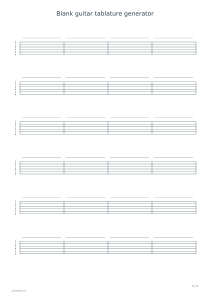
Make printable blank guitar tab with four, six, seven or eight strings. Choose rows and measure divisions, leave room for chord names or lyrics, and download your custom practice sheet.
Live preview210 × 297 mm
A4
Preview is scaled to fit. The PDF keeps the exact dimensions.
PDF and Print include all pages. PNG and SVG save the page shown.
For true-size printing: choose 100% / Actual size, match the paper size and turn off headers and footers. Printing guide ↗
Ready for your printer
Use this tab paper to capture a riff during a lesson, sketch a bass line or keep several fingerings of the same phrase together. The empty lines leave the musical decisions to you: the generator supplies a writing layout, not a transcription or a playable score.
💡A few useful answers
Does this turn a song into tablature?
No. This tool creates empty tab rows and optional writing spaces. It does not analyse audio, import notation, choose fingerings or add fret numbers. Enter your own original exercise or material you are entitled to use, and check the musical content before giving it to another player.
Can I use the same sheet for different tunings?
Yes. String numbering is independent of tuning. For example, six lines can be used for standard tuning or drop D, provided you write the chosen pitches or tuning name clearly. The sheet does not infer the instrument from four, seven or eight lines.
Why do some combinations not fit?
Every string group needs enough vertical space for its lines and the enabled chord or lyric areas. A landscape sheet is shorter vertically. Selecting fewer tab rows, removing an unused writing area or choosing A3 resolves this without squeezing the string spacing into an unreadable block.
Choose a tab layout you can write on
🎵Start with six strings for an ordinary guitar or four for a bass or ukulele. Seven- and eight-string layouts are also available. The small numbers run from string 1 at the top downwards. They identify string positions rather than pitches, so write your tuning in the page title when using an alternate setup.
Choose between two and twelve tab rows and one to eight measures across each row. Fewer rows provide larger gaps for annotations. More measure divisions shorten the writing area inside each bar. If the requested arrangement is too crowded for the paper and orientation, reduce the rows or use A3 before exporting.
Record strings, frets and musical context
Write a fret number directly on the line for the string being played. Zero means an open string; it is not a rest. Numbers vertically aligned can represent notes played together. These marks describe fingering, but a blank tab sheet does not specify rhythm automatically. Add rhythmic signs yourself or pair it with blank music staff paper.
The chord-name option leaves a short writing line above each measure. The lyrics option adds a continuous line below each tab row. Turn either off when it is unnecessary. Keep fuller finger-position diagrams on a separate guitar chord chart, where open strings, finger numbers and barres can be read without crowding the melody.
Turn the sheet into a practice record
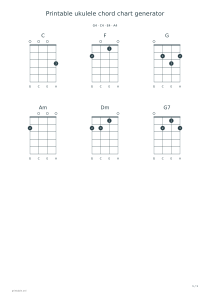
✏️For a lesson, reserve one row for the teacher’s phrase and another for your variation. Put the date, tuning and a short exercise name in the title, then note tempo and difficult transitions by hand. For four-string chord positions, the ukulele chord chart gives a separate reference in G–C–E–A tuning; it does not determine the tuning of your blank tab.
Check the preview before making a stack of copies: count the strings and make sure your handwriting fits within one measure. Print a single PDF page first. A blank tab has no calibrated fret spacing or instrument scale, so its useful size is the size that leaves your own numbers and timing marks comfortably readable.
Blank guitar tablature generator
Strings: 6
For a simple guitar riff, use A4 portrait, six strings, six rows and four measures per row. Keep the chord-name spaces and switch lyrics off. This produces 24 blank measures, with a separate place above each one to note the harmony while keeping the fret numbers on the string lines.
For a compact four-string song draft, choose A4 portrait, four strings, eight rows and two measures per row. Enable both chord and lyric spaces. The result contains 16 measures and eight lyric lines; write the tuning in the title because four strings alone does not identify the instrument.