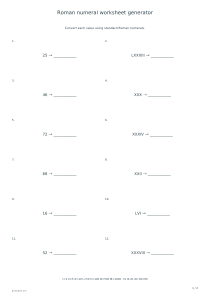
Create exercises converting ordinary numbers to Roman numerals or back again. Choose a maximum value, direction and question count, with an optional numeral reference and separate answer pages.
Live preview210 × 297 mm
A4
Preview is scaled to fit. The PDF keeps the exact dimensions.
PDF and Print include all pages. PNG and SVG save the page shown.
For true-size printing: choose 100% / Actual size, match the paper size and turn off headers and footers. Printing guide ↗
Ready for your printer
Roman notation combines symbols with fixed values according to particular rules. Learners need to interpret the whole sequence rather than adding every recognized letter without checking its order. These worksheets use standard subtractive notation in six pairs. Review the basic symbols and the difference between addition and subtraction before independent practice. Choose the conversion direction according to whether the goal is reading a supplied Roman numeral or constructing its canonical form from an ordinary number.
💡A few useful answers
Why is four written IV instead of four I symbols?
The generator uses standard subtractive notation. In IV, one is subtracted from five to represent four. Some clocks and historical examples use another form, but it is not the expected answer here. Explain the convention before asking learners to complete or check the worksheet.
Can I include zero or numbers above 3999?
No. Values are positive whole numbers from one to the selected maximum, never above 3999. The editor does not add overbars, negative signs or a zero symbol. Those belong to other conventions outside the standard exercise set provided by this tool.
Does the reference reveal every answer?
No. It lists the basic symbols and six subtractive pairs. Learners still need to construct or interpret the complete value. Use it while introducing the rules, then turn it off for recall. The separate answer pages are controlled by the answer setting and follow the practice sheets.
Choose the range and conversion direction
✏️Set the maximum to twenty, one hundred, one thousand or three thousand nine hundred ninety-nine. Questions use whole values from one through that limit. There is no zero, negative value or overbar notation for extended numbers. The maximum defines the allowed set, not a promise that the boundary itself appears. Begin with a smaller range while introducing symbols, then expand it once learners can explain the rules rather than only reproduce memorized examples.
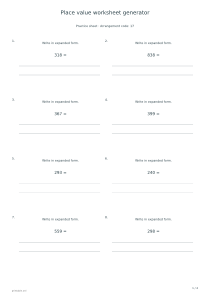
The basic symbols are I, V, X, L, C, D and M. Connect their values with ones, tens, hundreds and thousands. Place-value worksheets can help decompose the ordinary number before conversion. Roman notation does not use positional columns in the same way as decimal notation. The supporting activity explains the source quantity; it does not imply that a Roman letter's position has exactly the same function as a decimal digit's place.
Recognize six subtractive pairs
The standard subtractive pairs are IV, IX, XL, XC, CD and CM. Within those specified pairs, the smaller preceding symbol is subtracted from the larger one. Do not extend the rule to arbitrary combinations. Four is IV, nine is IX and forty is XL. Read a pair as a unit before continuing through the remaining symbols. The optional reference shows these pairs alongside the basic symbols without filling the worksheet's answer spaces.
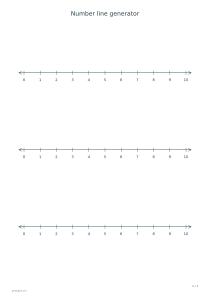
To Roman gives an ordinary number to convert. To Arabic gives a Roman numeral to read as an ordinary value. Mixed combines both directions. Check which form is requested before answering. A number line can separately compare the sizes of interpreted values. That discussion helps explain why a longer string of Roman letters need not represent a greater number than a shorter one, without changing the writing rules used in the exercise.
Check the complete numeral and its parts
📝Choose twelve, twenty-four or forty-eight questions, with twelve on each practice page. A positive arrangement code determines the set. Keep the range, direction, count and code when recreating a worksheet after discussion. Enable the reference for initial support or hide it for recall practice. The setting changes available help, not the canonical answer. Historical variants and the four-stroke notation found on some clock faces are outside this generator's chosen standard.
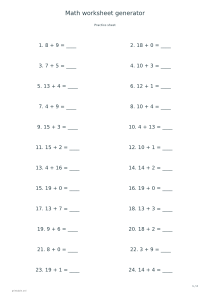
Optional solutions follow all exercise pages. Compare the whole numeral and identify whether an error concerns a basic symbol, an omitted part of the value or a subtractive pair. Use arithmetic worksheets for separate calculation practice; this activity is conversion rather than carrying out arithmetic in Roman notation. PDF and Print include the complete set. PNG, SVG and Share use the selected preview page. Handwritten responses require human checking rather than automatic letter recognition.
Roman numeral worksheet generator
Mixed values up to one hundred
Choose maximum 100, Mixed, twelve exercises and arrangement code 17. Enable the numeral reference and answers. The result has two pages: a practice sheet with twelve questions and its solution page. Before each response, decide whether Roman letters or an ordinary numerical value is required.
Choose maximum 3999, To Roman, twenty-four exercises and arrangement code 31. Disable the reference and enable answers. Two practice pages are followed by two solution pages, making four altogether. Check the standard subtractive pairs and every part of the value, not just the first written symbol.